
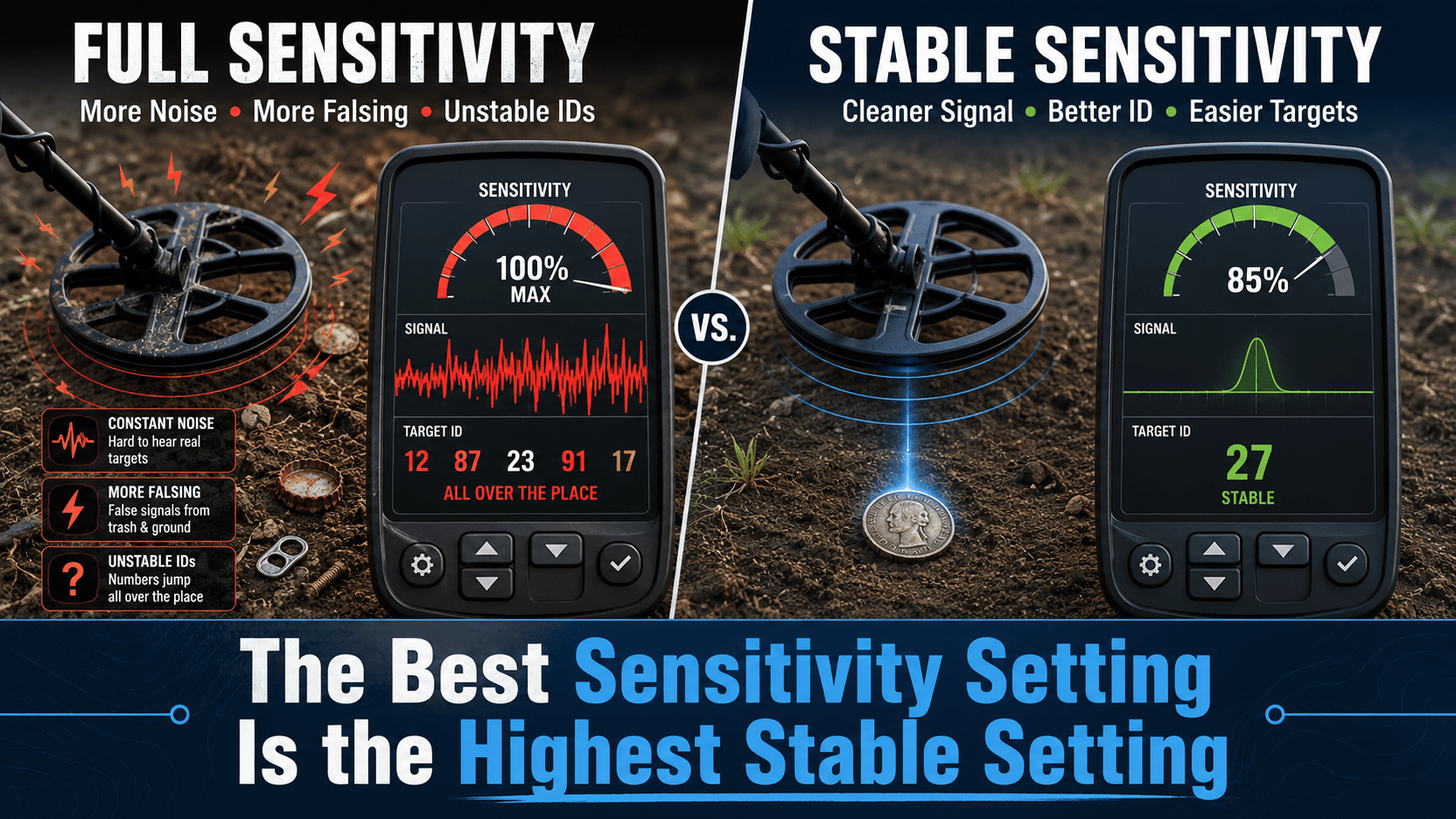
Why Running Your Metal Detector at Full Sensitivity Is Not Always the Best Idea
Maximum sensitivity may sound like maximum depth, but in real-world detecting conditions, turning the sensitivity all the way up can actually make good targets harder to hear and identify.
One of the most common assumptions in metal detecting is that a higher sensitivity setting automatically means greater depth. That idea is understandable. If sensitivity controls how strongly a detector responds to signals, it seems logical that setting it to maximum would help locate the deepest targets.
In perfect conditions, a very high setting may provide some additional response on weak targets. However, most detecting sites are not perfectly quiet. Soil mineralization, underground iron, electrical interference, salt, nearby detectors and other environmental factors can all produce signals of their own.
Sensitivity amplifies more than desirable targets. It can also amplify ground responses, electromagnetic interference and small variations that have nothing to do with a coin, relic or piece of jewelry. The best setting is therefore usually not the highest number available. It is the highest setting that allows the detector to remain stable and communicate useful information clearly.
What the Sensitivity Setting Actually Does
Sensitivity is commonly described as the detector's receive gain. It controls how much the signals received by the searchcoil are amplified before they are processed and presented to the user.
Increasing sensitivity allows weaker responses to become more noticeable. Those weak responses can come from deeper targets, very small targets or objects positioned at difficult angles. Unfortunately, weak unwanted signals are amplified at the same time.
Signals You Want
Coins, jewelry, relics, gold, deep conductors and small metal objects can all produce responses that benefit from additional amplification.
Signals You Do Not Want
Ground mineralization, salt response, electrical interference, hot rocks, tiny iron and searchcoil movement can also become more noticeable as sensitivity increases.
Think of it like increasing the volume on a weak radio station. The voice may become louder, but the static becomes louder too. At some point, adding more volume does not make the message easier to understand.
How Excessive Sensitivity Can Hurt Performance
1. Good targets can become hidden in noise
A deep target may produce only a faint, repeatable response. When the detector is also producing frequent false chirps, pops and random tones, that faint response can blend into the background. Lowering sensitivity slightly can quiet the detector enough for the real target response to stand out.
2. Target identification can become less dependable
Excessive noise can cause Target ID numbers and tones to jump around. A stable detector receives cleaner information, making it easier to recognize repeatable signals and decide whether a target is worth investigating.
3. Ground mineralization becomes more noticeable
Mineralized soil produces its own response. When sensitivity is too high for the ground conditions, the detector may respond as the coil approaches the soil, passes over patches of mineralization or moves across changing ground.
4. Iron falsing may increase
Rusty nails and irregular iron can produce brief high-tone responses, especially around their tips, edges or halos. Higher sensitivity may make these short false responses more prominent. This can make iron-contaminated locations sound busier and more difficult to interpret.
5. Electromagnetic interference becomes louder
Power lines, buried cables, buildings, chargers, electric fences and nearby detectors can introduce electromagnetic interference. A detector operating near its stability limit may begin producing random tones even while the coil is stationary.
6. Operator fatigue increases
Listening to constant false signals can become tiring. As fatigue builds, it becomes easier to ignore subtle signals or rush target evaluation. A quieter detector allows the operator to concentrate on repeatability, tone quality and Target ID behavior.
Stability Can Help You Find More Targets
A stable detector is not necessarily a weak detector. Stability allows you to recognize the difference between a random noise response and a repeatable target response.
Imagine two people searching the same location. One detector is set at maximum and produces a noise every few inches. The second detector is set a few levels lower and remains mostly quiet until the coil passes over a target.
The first detector may technically be operating with more amplification, but the second user will often have an easier time recognizing faint, repeatable signals. In practical detecting, signal clarity can be more valuable than raw gain.
How to Set Sensitivity Correctly
- Select the proper Search Mode for the location and the type of target you are searching for.
- Perform an automatic Noise Cancel with the coil stationary and away from obvious metal.
- Ground Balance the detector when required for the soil, beach or prospecting conditions.
- Begin with a moderate sensitivity level instead of immediately selecting maximum.
- Increase sensitivity gradually until random false signals begin to appear.
- Reduce the setting just enough for the detector to become stable again.
- Sweep the coil across a clear section of ground and make another small adjustment if ground noise remains.
This procedure finds the highest usable sensitivity for that particular location. The correct setting may change during the hunt as the soil, electrical interference, salt content or amount of nearby metal changes.
Do Not Copy a Sensitivity Number Without Considering the Site
A setting that works perfectly for someone in mild soil may be unstable in highly mineralized ground. A setting that works in an open field may be unusable beneath power lines or beside a building.
Detector model, searchcoil size, operating frequency, Search Mode, soil conditions and local interference all affect how much sensitivity can be used successfully.
Situations Where Lower Sensitivity May Work Better
Trashy Parks
A lower setting can reduce the detection footprint of small unwanted objects and make nearby targets easier to separate and interpret.
Iron-Contaminated Sites
Reducing excessive amplification may calm iron falsing and make repeatable nonferrous responses easier to recognize.
Mineralized Ground
Lower sensitivity can reduce responses caused by mineralization and improve the distinction between ground noise and metal targets.
Saltwater Beaches
Wet salt is conductive and can create a strong response. Proper beach modes and a stable sensitivity setting are often more effective than maximum gain.
Electrical Interference
Near power lines, homes or electronic equipment, a small sensitivity reduction can greatly improve stability.
Shallow Target Areas
When most desired targets are shallow, maximum depth may offer little advantage while increasing responses from small trash and nearby objects.
Does Lowering Sensitivity Always Reduce Depth?
Lowering sensitivity can reduce the detector's response to extremely weak targets. However, the difference between maximum sensitivity and the highest stable setting is often less important than many users expect.
A target is only useful if the operator can recognize it. A faint response that is surrounded by random noise may be technically detectable but practically easy to miss. A slightly lower setting may produce a cleaner and more repeatable response, even if the raw signal is marginally weaker.
Searchcoil control, overlapping sweeps, proper Ground Balance, an appropriate Search Mode and careful listening can contribute as much to real-world success as the sensitivity number shown on the screen.
When Maximum Sensitivity Can Be Useful
Maximum sensitivity is not always wrong. It may be useful when the detector remains stable, the ground is mild, electrical interference is low and the site contains relatively little unwanted metal.
An experienced operator may also temporarily increase sensitivity while examining a suspected deep target. This can provide additional information without requiring the detector to run at maximum throughout the entire hunt.
The important distinction is that maximum sensitivity should be selected because conditions allow it, not simply because the control has a maximum position.
Common Sensitivity Questions
Should I always run my detector as high as it will go?
No. Run it at the highest setting that remains stable in the current conditions. Maximum is appropriate only when the detector remains quiet and target responses stay understandable.
Can too much sensitivity cause false signals?
Yes. It can amplify electromagnetic interference, ground mineralization, salt response, iron falsing and small movements of the searchcoil or cable.
Should I lower sensitivity before performing Noise Cancel?
Usually, perform Noise Cancel first. Ground Balance when required, and then reduce sensitivity only if excessive noise remains.
Is a quiet detector missing targets?
Not necessarily. A stable threshold or quiet search can make subtle target responses easier to recognize because they are not competing with constant false signals.
Should beginners use a lower setting?
Starting at a moderate level can make it easier to learn the detector's tones and Target ID behavior. Sensitivity can then be increased gradually as experience grows.
The Best Sensitivity Setting Is the Highest Stable Setting
Do not judge your detector's performance only by the number on its sensitivity display. Proper setup, stability and clear target information matter more than running every control at maximum. Perform Noise Cancel, Ground Balance when needed, increase sensitivity gradually, and stop when additional gain begins creating more noise than useful information.